Result: the hypothesis failed (FAIL). At 99% accuracy, 48% [25–70] (Qwen 3.6) and 63% [39–68] (Gemma 4) of fields can be approved without review; the target was 70%. The confidence score itself works and is well calibrated.
All data is 100% synthetic. The companies, people and company IDs on the documents are made up. No real documents were used in this experiment.
Verdict
We set the success criteria in advance, before the first measurement. All of them had to pass. The score and calibration passed; coverage did not.
| Qwen 3.6 | Gemma 4 | Threshold set in advance | |
|---|---|---|---|
| How well the score separates wrong fields from correct ones (AUROC) | 0.903 [0.878–0.926] | 0.926 [0.911–0.941] | at least 0.85 ✅ |
| Score calibration (ECE, lower is better) | 0.012 | 0.012 | at most 0.05 ✅ |
| Share of fields that can be approved without review while keeping at least 99% accuracy on them (coverage) | 48% [25–70] | 63% [39–68] | at least 70% ❌ |
n = 450 synthetic Slovak business documents, about 5,300 to 5,700 fields per model. Square brackets show the 95% interval (bootstrap by document).
In plain terms:
- The score works. It separates wrong fields from correct ones well. That doesn’t mean it “catches 90% of errors”: AUROC measures how well the score ranks fields from most to least certain.
- The score doesn’t overclaim. When it says it is 95% sure, it is right on average within about 1 point (ECE 0.012).
- But it isn’t enough. At 99% accuracy on approved fields, only about half the fields can skip review. If we approved 70% of fields, accuracy on them would be 98.2% for both models. It missed the target by less than 1 point.
- Why the interval is so wide: accuracy on approved fields stays at 99.0–99.5% anywhere from about 20% to 60% coverage. The curve is flat at that boundary, so a small change in the data moves the 99% point a long way.
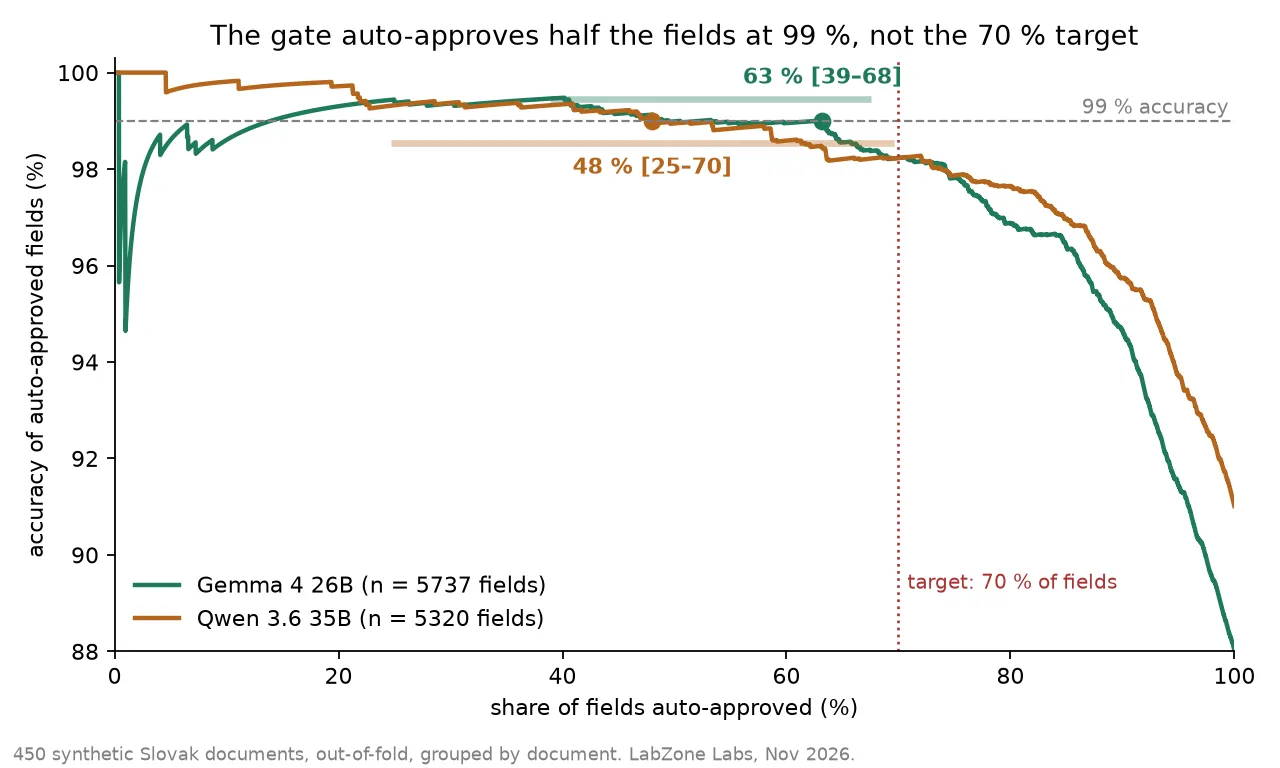
The more fields the gate approves (x axis), the lower the accuracy on them (y axis). At the 99% line, Qwen 3.6 stops at 48% [25–70] and Gemma 4 at 63% [39–68] of fields; the target was 70%. 450 synthetic documents.
The question
In our previous lab, Rewrite or review?, we found that local models come close to the cloud at extracting data from documents, but flag only 5–10% of their own errors. Anyone putting AI on documents can’t rely on the model to warn them.
This time we asked: can a combination of signals tell which fields can be approved without review and which need to go further, to a person or to the cloud?
How we measured
- Data: 450 synthetic Slovak business documents with the correct answer field by field. 60 documents from the previous lab and 390 new ones, 30 types in total (invoices, delivery notes, construction logs, inspection reports, contracts and more). Clean, scanned and degraded (faded, skewed, blurred). The unit of measurement is one field or one line item.
- Local models: Qwen 3.6 (35B) and Gemma 4 (26B) locally via Ollama, page image straight into the model, same prompt and schema as the previous lab. For each document, 1 answer plus 5 extra samples at a higher temperature (0.7). All on one mini PC with a Ryzen AI 9 HX 370, ≈ €1,474.
- Cloud for the hybrid: Claude Haiku 5.5 and Claude Sonnet 5.5, one pass per document.
- Signals for each field: agreement of the 5 samples with the answer, token-level model confidence (logprobs), agreement between Qwen and Gemma, rule checks (date, company ID, IBAN, tax ID, totals), empty value, field and document type, and the model’s own “review” flag.
- Combining the signals: logistic regression with recalibration, cross-validated by document (no document is scored by a model that saw it in training). 95% intervals by bootstrap over documents.
- Success thresholds were set before the first run: AUROC at least 0.85, accuracy of approved fields at least 99% at coverage of at least 70%, ECE at most 0.05.
Which signals work
AUROC of each signal on its own (Qwen 3.6 / Gemma 4), n = 450 documents:
| Signal | Qwen 3.6 | Gemma 4 |
|---|---|---|
| Qwen and Gemma agree | 0.80 | 0.82 |
| Lowest token confidence (logprob min) | 0.80 | 0.75 |
| 5 samples agree with the answer | 0.78 | 0.70 |
| Model’s own “review” flag | 0.53 | 0.52 |
| Rule checks | 0.53 | 0.53 |
| All combined | 0.903 | 0.926 |
- Agreement between the two models and logprobs carry most of the information. The model’s own flag and the rules carry almost nothing on their own (0.5 is chance).
- No signal is enough by itself; together they work.
- Gemma reaches higher coverage than the more accurate Qwen because its strongest signal is agreement with Qwen: a weaker model checked by a stronger one.
- For comparison: Gemma’s AUROC (0.926) is close to the 0.928 reported by the EXTRACTCONF study (GPT-4o, English invoices). Different data and models, so this is a similar result, not a replication.
Hybrid: what you can use
What to do with fields the gate doesn’t approve? We compared options on all 450 documents (Qwen 3.6, accuracy over all fields of all documents):
| Unapproved fields go to | Accuracy | Fields to a person | Cloud per document |
|---|---|---|---|
| Value from Haiku | 95.9% | 1% | $0.0010 |
| Value from Sonnet | 97.9% | 1% | $0.0163 |
| Haiku as checker: agrees with local model = keep, otherwise a person | 97.9% | 12% | $0.0010 |
| Sonnet as checker: agrees = keep, otherwise a person | 98.7% | 12% | $0.0163 |
| For comparison, no gate: Sonnet alone | 97.9% | 0% | $0.0175 |
| Haiku alone | 95.7% | 0% | $0.0011 |
| Qwen 3.6 alone, local | 79.0% | 0% | $0 |
Accuracy is computed over all fields of all 450 documents, the same way for every row. Documents where the local model returned invalid output go entirely to that row’s cloud model, and table rows the local model skipped count as errors.
Note: the options with a person assume the person fixes everything. These are upper bounds, not measured human performance. Gemma 4 comes out 0.2 to 0.4 points lower. No option reached 99%.
Recommendation: local model, Haiku as checker, and a person when they disagree. 97.9% accuracy, the same as Sonnet alone, at 1/17 of the cloud cost ($0.001 instead of $0.0175 per document), with 12% of fields going to a person.
When Sonnet? Sonnet as checker removes 0.8 points of errors. At about 13 fields per document that is about 100 fewer wrong fields per 1,000 documents for roughly $15 more, so about $0.15 per error avoided. It only pays off where a single error costs more: the amount on an invoice to be paid, an IBAN. For other fields Haiku is the better choice.
This is what review looks like in practice: each field is coloured by where the gate sent it (green: approved automatically, orange: checked by Haiku, red: a person), with its confidence.
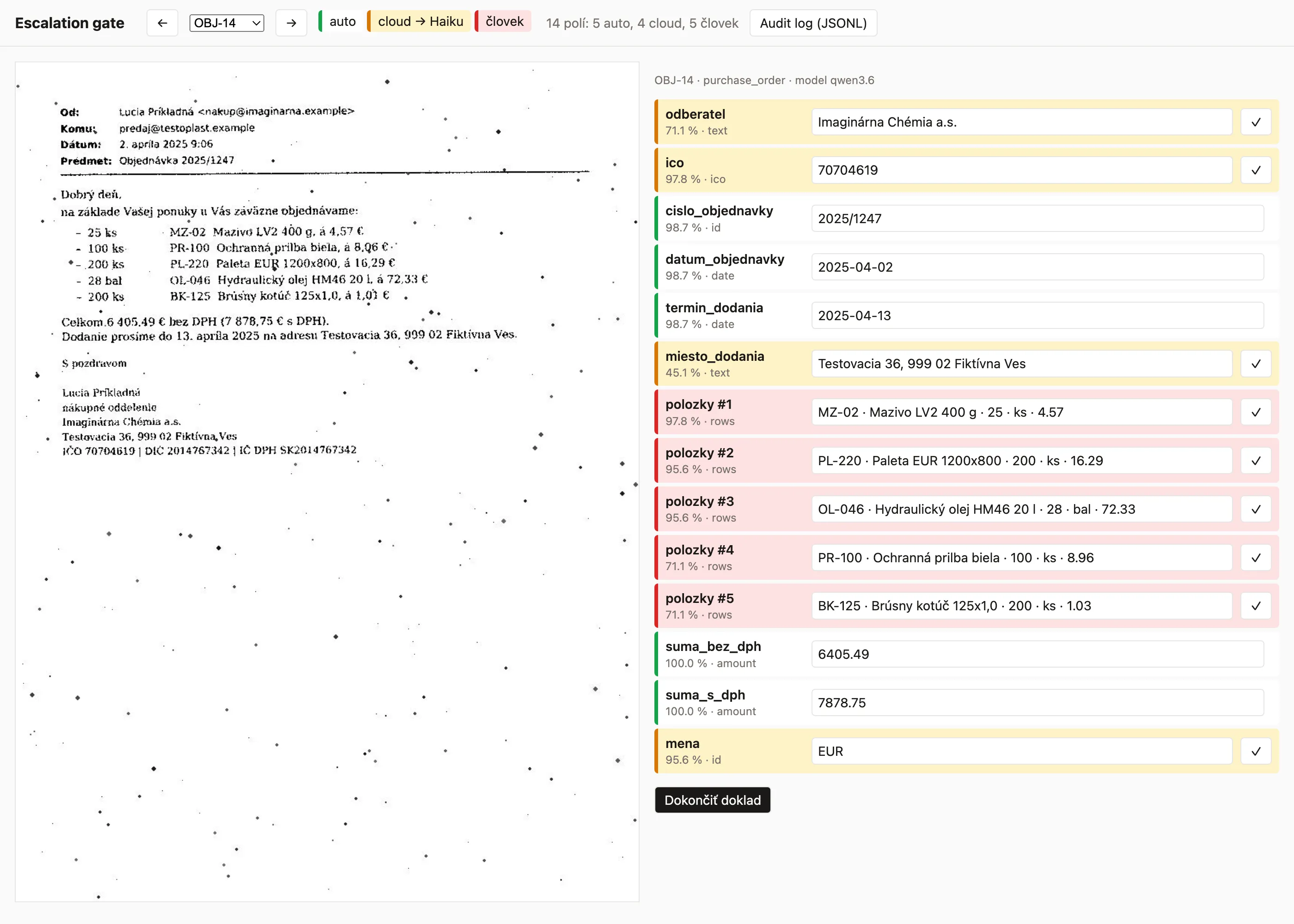
Example on a synthetic document. The company, person, address and numbers are made up.
Work out what this would mean for your volumes and error cost in the document processing calculator.
What failed
- Coverage. The score is accurate and honest, but local models get degraded scans wrong too often to approve 70% of fields at 99%.
- Whole documents still go to the cloud. Almost every document has at least one field the gate doesn’t approve (Qwen 391 of 422 documents, Gemma 366 of 437, i.e. 84 to 93%), and the whole document goes to the cloud. That weakens the “your data stays with you” argument and barely lowers the cloud cost (Sonnet $0.0175 → $0.0163 per document).
- The cloud isn’t a clean rescue. The fields the gate passes on are hard for every model. Sonnet made 124 errors on this set, mostly misread digits and diacritics on degraded scans.
- Samples are slow. 5 samples add 112 to 141 seconds per document (median) on top of 23 to 27 seconds for the answer itself.
- Long tables didn’t fit. 28 (Qwen) and 13 (Gemma) of the 450 documents with tables over 20 rows hit the output length limit and returned a truncated result. These documents go entirely to the cloud.
- The gate can’t save a small model. Qwen3-VL 4B reached 80.4% field accuracy on interim data and near-zero coverage at 99%. We stopped that run early.
What’s next
- Send only unapproved fields to the cloud, not whole documents, so most content stays local, and check whether accuracy changes.
- Rerun the 41 truncated documents with a higher output limit.
- Fewer samples: the 5 samples are the slowest part. Without them, AUROC drops from 0.903 to 0.866 (Qwen) and from 0.926 to 0.914 (Gemma). Coverage at 99% without samples: Qwen 23% [11–48] instead of 48% [25–70], Gemma 58% [0.4–69] instead of 63% [39–68]. The intervals overlap, so the drop in coverage is likely, not confirmed. The firmer evidence that samples help is the AUROC drop for Qwen. Test 2 to 3 samples.
- Gemma in an EU cloud: repeat the measurement there (logprobs may not be available, so calibration has to be redone).
Changes from the plan
What changed compared with the plan set before measuring:
- We used Haiku instead of Sonnet as the cloud model (cost). Sonnet was added later for the hybrid comparison.
- The small model (Qwen3-VL 4B) was stopped early; its results are interim. Another planned small pipeline was withdrawn before it ran.
- After the first analysis we corrected the set of fields: the main evaluation now excludes fields the gate can’t see (documents with invalid output, rows the model skipped). The verdict didn’t change; the coverage FAIL holds with them included too.
Who it’s for
Owners and managers of companies with paper-heavy admin (invoices, delivery notes, reports) who are considering AI but worry about errors or sending data to the cloud. And technical people interested in the method.
Data
All data is synthetic; companies, people and company IDs are made up.
Model names are used only to identify what we measured. LabZone is not affiliated with the model makers, and they have not endorsed these results.