The question
If a firm’s data must stay in the building, can a model running on a single office mini PC do the work of our internal LLM-based tool? And what, in numbers, does that cost against a cloud decision model?
This is one internal task: yes/no decisions in document classification over publicly available texts, checked against a human label. A yes only counts when the model finds a quote in the text. We are not claiming a general ranking of models.
What we measured
25 November 2026, one run, 7 judges, 126 human-labelled decisions across 5 questions (about 25 labels per question). Metric: Youden’s J (1 = perfect, 0 = coin flip), with a paired bootstrap and 95% intervals.
Local judges ran on one mini PC: AMD Ryzen AI 9 HX 370, 60 GB RAM, integrated GPU, no cloud. The baseline is our internal LLM-based tool on the older Qwen3.6-35B-A3B (Ollama, Q4_K_M), running on a shared server. Gemini Decision 1 ran in the cloud and saw only the same public text as the other judges; no client data was sent anywhere.
Selection check
We excluded 6 card items because they had passed the pre-check. Gemini Decision 1 is therefore reported on 120 items from the unfiltered queue. The other judges remain on the original 126 items; we do not have 120-item figures for them and do not invent any.
| Judge | Youden’s J | n | Time per decision |
|---|---|---|---|
| Gemini Decision 1 (cloud) | 0.83 | 120 | 4 s |
| Qwen3.6-35B-A3B, mini PC | 0.73 | 126 | 2.9 s |
| pplx-decider 27B, mini PC | 0.73 | 126 | 2.9 s |
| pplx-decider-flash 4B, mini PC (community build) | 0.70 | 126 | 0.6 s |
| Qwen3.6-35B-A3B, our tool | 0.68 | 126 | — |
| Gemma 4 26B, mini PC | 0.64 | 126 | 5.3 s |
| Qwen3.8 27B (newest), mini PC | 0.46 | 126 | 9.4 s |
The time of our internal tool is from a busy shared server, not a property of the model, so it is not in the table.
What we found
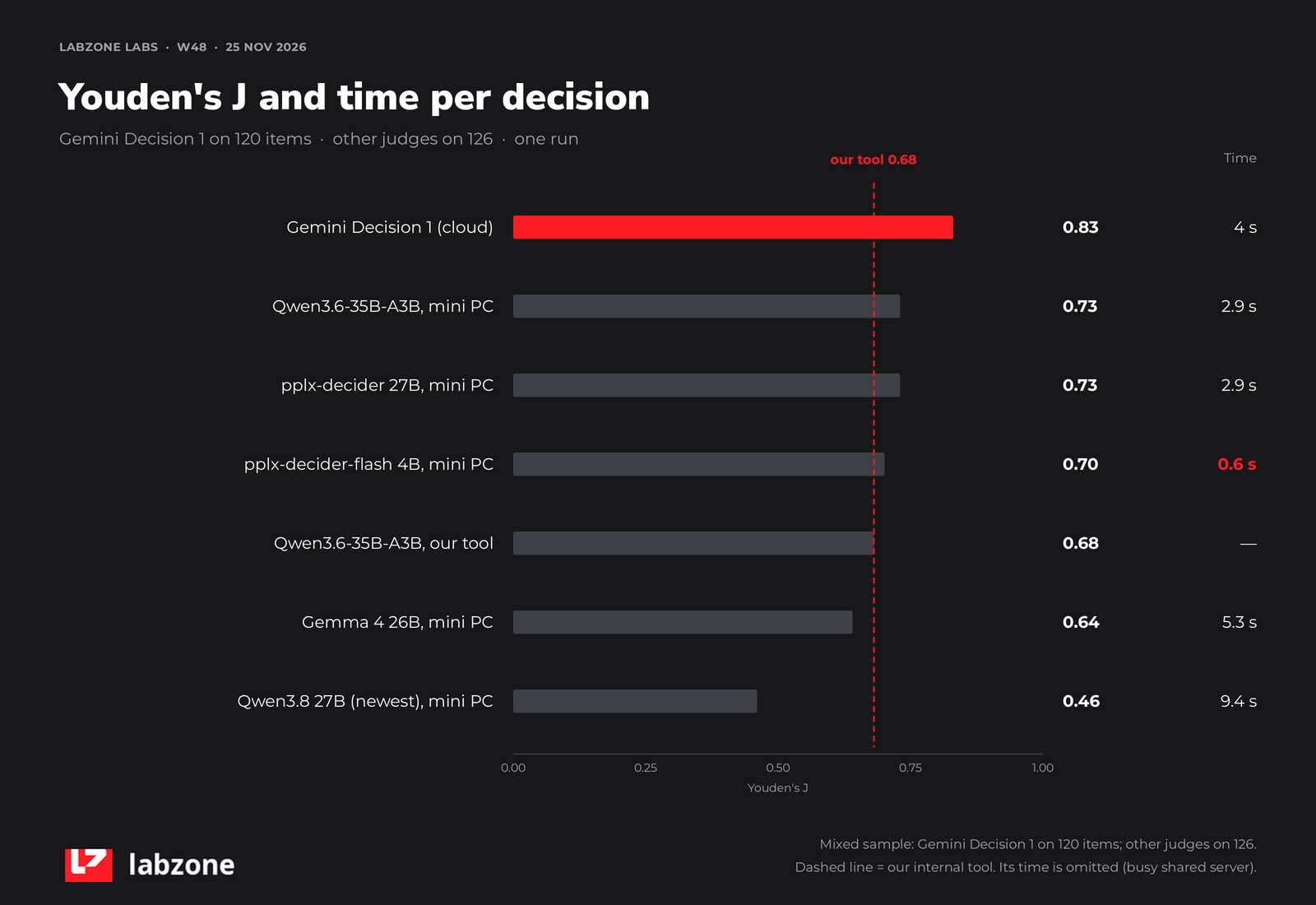
- Only Gemini Decision 1 clearly beats our internal tool: +0.13 J, 95% interval +0.02 to +0.25 (0.83 vs 0.68, n = 120).
- Every local judge came out practically the same as our internal tool, except Qwen3.8 27B, which is clearly worse (0.46 vs 0.68, n = 126). The differences (apart from this exception) were too small to say which one is better. The newest model we tested was not the best for this task.
- The fastest local judge, pplx-decider-flash 4B (a community build), answered in 0.6 s, offline, at 0.70 J — practically indistinguishable from our tool.
- Same model, different runtime: one classifier fell from 0.65 to 0.35. Pooled, it was a tie. A swap without an eval on labelled cases can quietly break one classifier even when the headline number barely moves.
What we can’t tell from this
At n = 126, most pairwise differences against our internal tool were too small to say which model is better. We say so on purpose. The only local result we treat as clear is Qwen3.8 27B being worse. “Practically the same” is not the same as “equal”.
Limits
One internal task, about 25 labels per question, one hardware setup, one run on 25 November 2026. Gemini’s figure is on 120 items; the other judges are on 126. Enough to measure this trade-off on this task, not a general ranking and not a guarantee on someone else’s documents.
What we don’t claim
- We do not treat the latency of our internal tool as a speed comparison.
- We do not claim that these models route uncertain cases to a person.
- We do not call anything “the best model”, and we do not publish a general league table.
Related: LabZone Bench
This lab is a judge comparison on one internal classification task. It is not our coding-agent benchmark. The mini PC is the same hardware class (HX 370) that we also use there. Live coding-agent scores, method and limits: bench.labzone.tech.
Try this on your documents
A 15-minute audit is free: book a time. The solution will run at your site. Your data stays yours.